Advanced Kernel Threat Detection for Blue Teams
We help security vendors and defenders detect and validate kernel-level threats in Linux and AWS cloud environments through controlled adversarial research, detection engineering, and defensive products.


Innovative approach in security.
★★★★★
Detect rootkits today!
We develop advanced tools for rootkit detection.
What we do
We help blue teams and security vendors detect kernel-level threats through hands-on research and practical detection engineering.
Our work focuses on active rootkit research: we intentionally build advanced loadable kernel modules (LKMs) to study real attacker techniques, then use those findings to develop reliable detection strategies and defensive insights.
Everything we deliver is evidence-driven, reproducible, and designed to strengthen defensive capabilities in real environments.
In addition, we develop advanced compiler/obfuscation passes that secure generated code.


Why Hands-On Adversarial Testing
Real Threats, Not Simulations
Detect What Attackers Actually Do
Validate Assumptions Before Attackers Do
Build Stronger Detection Engines
Safe, Controlled, Defensive


Security Research Services
We help blue teams and security vendors strengthen Linux kernel and compiler defenses through practical research and detection-focused engineering.
Kernel Module Security
We develop realistic kernel threat modules to study how advanced attacks work in practice, then use those insights to design accurate detection techniques, test cases, and defensive guidance for security products and internal teams.


Compiler & Binary Security
We analyze binaries to expose compiler-level blind spots and hardening gaps, helping defenders better understand what survives optimization and obfuscation in real-world builds.
We deliver hands-on, lab-driven training on Linux kernel threats and defenses for modern cloud and AWS workloads, focused on detection, validation, and defensive engineering—not exploitation.
Trainings & Knowledge Transfer


Our Products
Explore our security-focused tools and services built for blue teams, security vendors, and cloud operators.
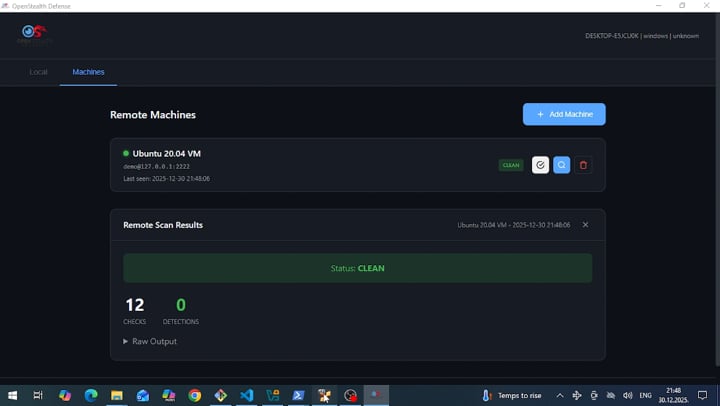
Open Stealth Defense Platform
A GUI-based Linux kernel threat detection platform for blue teams.
Runs on Windows, Linux, and macOS, and allows teams to configure and monitor remote Linux systems and cloud VMs.
The platform remotely executes advanced detection logic to identify kernel-level threats and rootkits, helping teams validate and strengthen their defensive capabilities in real environments.
OpenStealth Research LKM (Internal)
An internal kernel research module used as a controlled testbed for validating detection techniques in the OpenStealth Defense Platform.
It enables realistic threat simulation and deep kernel behavior analysis. Findings are selectively shared through research outputs, while the module itself remains private and purpose-built to improve defensive accuracy.
Compiler Obfuscation & Hardening Passes
A set of architecture-agnostic compiler passes for toolchains such as LLVM and GCC.
Designed to improve binary resilience across x86, ARM, and RISC-V, these passes help reduce reverse-engineering exposure and uncover compiler-stage security blind spots.
Training & Awareness Programs
Hands-on training for Linux operators, administrators, and security teams, focused on understanding kernel-level threats in on-prem and cloud environments (including AWS).
Training emphasizes detection, validation, and defensive response, helping teams better protect Linux-based infrastructure.

Contact Us
Reach out for inquiries about Linux security research and projects.